Application Engineering
A Brief History of Screw Threads
The first practical application of the humble screw thread was developed by Archimedes in the 3rd
century B.C. He used a pipe wrapped around a shaft in a helical pattern to make a crude bilge
pump for ships. Later Archimedes wrote a mathematical treatise on spirals. The family of screw
threads including Acme, Unified, Trapezoidal and ISO are known as Archimedean screws because
they exhibit straight thread profiles in their axial sections. Archimedes took the basic
inclined plane and wrapped it into a spiral shape. Rotating the spiral in one direction raised
the load and rotating it in the other direction lowered the load. In the 16th century, Leonardo
Da Vinci conceived the first flying machines which used the screw thread principle. Today's
propeller driven ships, airplanes and helicopters can be thought of as utilizing screws against
air or water, which act as the mating nuts. Early screws were made by wrapping wire around
plain bar. Nuts were made of softer material (copper for example) by forging them around the
wire wrapped rod. In fact, modern day manufacture of earth drills and material augers still
uses this technique. Later screws were cut from solid bar using single point cutting tools or
chasers. Modern screw thread rolling whereby threads are formed completely by chipless cold
forging first began in the late 1800s. Heavy thread rolling of Acme, Ballscrew and worm thread
forms began in the late 1950s. Because of its many advantages, thread rolling is the preferred
method of manufacture today. Early screw manufacturing suffered from the absence of accurate
and powerful machinery capable of holding minimally accurate tolerances. This was compounded
by the lack of accurate inspection methods. For many years screws and nuts were manufactured
and used in matched sets, and as a result were not interchangeable.
FIGURE 15

FIGURE 16

Screw Thread Standards back to top
In the mid 1800s Sir Joseph Whitworth developed the first screw thread standard for a
fastening thread which now bears his name. This standard detailed the diameter and pitch
combinations along with limits of size for each combination. Later, Britain, Canada and the
United States developed the Unified Screw Thread standard which is in wide use today, and which
was copied conceptually by the International Standards Organization when that body standardized
the ISO fastener threads and the metric Trapezoidal power screw threads. Most screw thread
standards are structured as functions of major diameter and pitch. All thread features and
limits of size are deterdetermined by the thread major diameter and thread pitch. Acme screw
threads were formulated in the 1890s to replace square threads and a varied group of other
power transmission thread forms. Today, Acme and metric Trapezoidal screw threads are highly
standardized by government and industry associations. Users are guaranteed good fitups when
using nut and screw products from different manufacturers only if both sources adhere to the
applicable standards.
Basics of Actuating Screws back to top
Actuating screw threads include Acmes, Hileads(r), Torqsplines(r), Ballscrews, Freewheeling
Ballscrews and many other special screws such as Stub Acme, 60 degree Stub, Buttress and Square
threads. Unified and ISO fastener "Vee" threads should not be used for actuation as their 30°
flank angles and finer pitches are designed for fastening and locking down. (See Identifying
Screw Threads section for more detailed information on types and forms of screw threads.)
Actuating screws provide a compact means for transmitting motion and power. They are ideal
for replacing hydraulic and pneumatic drive systems as they require no compressors, pumps,
piping, filters, tanks, valves or any other support items required by these systems. Also,
screws don't leak so there are no problems with seals which are so common to hydraulic and
pneumatic systems. And, screw systems are quiet running - no noisy compressors, pumps or
exhaust valves. Screw systems are simple, reliable and easy to utilize.
Screw Motions back to top
There are four distinct motion converting actions that can be produced by actuating screws and
nuts. The two most common involve torque conversion to thrust. In Figure 17, the screw is
rotated (torqued) and the nut moves linearly producing thrust or the nut is rotated (torqued)
and the screw moves linearly. The two less common motions involve thrust conversion to torque.
In Figure 18, the nut undergoes a linear force (thrust) and the screw rotates or the screw
undergoes a linear force (thrust) and the nut rotates. These two motions are commonly referred
to as "backdriving", "overhauling", or, improperly, "reversing".
FIGURE 17

FIGURE 18

Types of Screws back to top
There are two general type of screws used to create motion and power: Power screws and Ballscrews.
Power screws are the simplest of these as they have only two main elements, the screw and the nut.
Power Screws back to top
Power screws cover a wide variety of screw series and include Acmes, Hileads(r), Torqsplines(r)
and other special series (not offered in this catalog but produced for OEM customers) such as Stub
Acme, Trapezoidal ("metric Acme") and Buttress. Regardless of the thread series, an externally
threaded screw mates with an internally threaded nut of the same thread form; when either member
rotates, the other member translates. Contact between the screw and nut is sliding friction at the
screw and nut interface surface (Figure 19). Efficiencies vary from 20% - 30% for standard Acmes
to 25% - 40% for Hileads(r) and up to 75% for some Torqsplines(r). Efficiency of any power screw
and nut juis dependent upon the coefficient of friction between the screw and nut materials, the
lead angle and the pressure angle of the screw thread. Of these, the lead angle has the greatest
effect, the coefficient of friction has a secondary effect and the pressure angle has a minimal
effect. For the exact formula of efficiency as a function of these variables, see the Useful
Formulas section. Efficiencies of power screws may vary with load. When the load increases, unit
pressure increases and the coefficient of friction can drop. This is especially true for plastic
nuts but has also been observed with bronze nuts. Power screws in the Acme screw series (single
start screws) are self-locking. This means that they can sustain loads without the use of holding
brakes. In vibrating environments, some locking means may be needed, but Acme screws rarely
require brakes. This makes them simple and inexpensive for use in many different applications
such as machine tools, clamping mechanisms, farm machinery, medical equipment, aerospace and
other mechanisms of many industries. Power screws are typically made from carbon steel, alloy
steel, or stainless steel and they are usually used with bronze, plastic, or steel mating nuts.
Bronze and plastic nuts are popular for higher duty applications and they provide low
coefficients of friction for minimizing drive torques. Steel nuts are used for only occasional
adjustment and limited duty so as to avoid galling of like materials. For more information about
using steel Acme nuts, see Roton Engineering Bulletin No. 971.
FIGURE 19

Ballscrews back to top
Ballscrews, first invented in the late 1800s, did not come into widespread use until the 1940s
when they were adapted for use in automotive steering gear. Since that time they have been used
in a variety of industrial and commercial applications due to their high efficiency and predictable
service life. Ballscrews utilize a series of ball bearings between the screw and nut threads so
that movement is achieved through rolling friction (see Figure 20). Power screws and Ballscrews
are analogous to bushings (sometimes called plain bearings) and ball bearings. Like ball bearings,
Ballscrews exhibit low friction and predictable service life. Screws, nuts, and balls are made of
heat treated steel to optimize performance and resist Hertzian stresses. Efficiency for Ballscrews
is 90% and does not vary with load. Because of their high efficiency, Ballscrews are never
self-locking. A holding brake is necessary to sustain loads as Ballscrews can easily convert thrust
to torque and backdrive a gearbox or motor or other drive system elements.
FIGURE 20

Load back to top
The primary concern in any screw and nut system is the amount of load to be moved. The load must be
determined by the designer before the proper type and size of screw can be selected. If the load is
to be moved vertically, the nut load is equal to the weight to be moved plus the friction load. If
a load is to be moved horizontally, the weight must be multiplied by the coefficient of friction to
determine the net load on the nut. Loads can also be measured with a spring scale or dynamometer.
For loads which are neither horizontal or vertical, this may be the easiest method. (Refer to Table
39 for Typical Coefficients of Friction.) The higher the load, the larger the size of the screw and
nut that will be needed. Using the Screw/Nut Engineering Data provided for each screw series, select
a size with static and operating load ratings as large or larger than the application loading.
TABLE 39
Materials |
Fricton Coefficients |
| Steel on Steel (dry) |
.80 |
| Steel on Steel (lubricated) |
.16 |
| Steel on Bronze (dry) |
.40 |
| Steel on Bronze (lubricated |
.15 |
| Steel on Brass (dry) |
.35 |
| Steel on Brass (lubricated) |
.19 |
| Steel on Wood (dry) |
.40 |
| Steel on Wood (lubricated) |
.20 |
| Steel on Cast Iron (dry) |
.23 |
| Steel on Cast Iron (lubricated) |
.15 |
| Steel on Plastic (dry) |
.15 |
| Steel on Plastic (lubricated) |
.125 |
Types of Loading back to top
Tension loading is always preferred in any screw and nut system. In compression loading, screws may
fail by elastic instability (buckling) and safe column loading must be investigated. (See Column
Loading, and Torsional & Axial Deflection sections for more comments on the effects of load on screw
and nut systems.) All screw and nut systems perform best when loaded on their axes. This is called
axial loading because the screw and nut are loaded in line with the central axis. Radial (side)
loading and off center (moment) loads are detrimental and should be avoided or minimized.
FIGURE 21

FIGURE 22

FIGURE 23

FIGURE 24

FIGURE 25

Drive Torque back to top
Using the drive torque ratios from the Screw/Nut Engineering Data for the selected screw series, the
torque can be easily calculated. The drive torque is equal to the load (lbs.) times the drive torque
ratio (in.-lbs./lbs.). For example, the torque required to drive 1,000 lbs. using a 1 - 5 size Acme
screw is 102 in. - lbs. (1,000 lbs. x .102 in. - lbs./lbs. = 102 in.-lbs.). The drive torque ratios
listed are for the screw and nut only. Support bearings and other drive components will require
additional torque. Also, additional torque may be needed for acceleration and to overcome starting
friction in the drive system which is often higher than running friction. When sizing motors and
other drive components, this additional torque should be included.
Efficiency and Backdriving back to top
The mechanical efficiency of screw drive systems is often confusing. This is because unlike most
power transmission components, V-belts, sheaves, timing belts, chain drives, and gear systems (with
the notable exception of worm gear systems), screw drive systems actually exhibit two efficiencies -
one in the drive direction (torque to thrust conversion) and one in the backdrive direction (thrust
to torque conversion). The Efficiencies vs. Lead Angle graph (Figure 26) shows the two efficiency
curves for a continuum of general screws against a mating Bronze nut (coefficient of friction .15).
For a screw at 8° lead angle, the forward efficiency is 45% and the backdrive efficiency is -13%.
The negative backdrive efficiency means that the screw is self-locking, that is, some drive torque
is required to lower a load. Assuming a lead of 1 in./rev. and a load of 1,000 lbs. the forward
drive and backdrive torques can be calculated by using the efficiencies from the graph and the
equations for drive torque shown in the Useful Formulas section. Note that the backdrive torque
value is negative when the backdrive efficiency is negative. This indicates that the screw is
self-locking and that torque in a direction opposite from the drive direction is needed to lower
the load. Again with reference to the Efficiencies vs. Lead Angle graph (Figure 26), as the lead
angle increases, a screw with a lead angle of 20° has a forward efficiency of 65% and a backdrive
efficiency of 52%. The backdrive efficiency is now greater than zero indicating that the screw is
not self-locking and braking torque will be needed to sustain a load. Looking at it another way,
the backdrive torque calculated represents the torque produced on the screw by a linear force on
the nut. Hilead(r) and Torqspline(r) screws use the principle that increasing lead angles
dramatically increases the efficiency of power screws. The Efficiencies vs. Lead Angle graph shows
efficiencies for the three power screw series - Acmes, Hileads(r) and Torqsplines(r). Note that
efficiency rises steadily as the lead angle increases. Ballscrews, which use rolling friction in
place of the sliding friction of the other screw series, exhibit efficiencies that do not change
with lead angle. The Efficiencies vs. Lead Angle graph shows Ballscrew forward and backdrive
efficiency at constant values of 90% forward efficiency and 80% backdrive efficiency for the
entire range of lead angles. In actual laboratory measurements, low lead angle Ballscrews do show
slightly more efficiency than larger lead angle Ballscrews, but not enough to be significant for
commercial Ballscrew applications. No problems should be encountered by assuming 90% forward drive
and 80% backdrive efficiency for the entire range of Ballscrew leads and lead angles.
FIGURE 26

Speed back to top
Linear speed is dictated by the functional requirements of the application. Rotational speed is a
function of the linear speed and the lead of the screw. Rotational speed (rpm) is equal to the
linear speed (in./minute) divided by the lead of the screw (in./rev.). Leads are listed in the
Screw/Nut Engineering Data for each screw series and size. For example, a 1 1/2 x .500 Hilead(r)
screw is to move a load at 100 in./min. This will require a rotational input speed of 200 rpm (100
ipm/.500 ipr = 200 rpm).
Speed - Power Screws back to top
Acme screws are most commonly used at 100 rpm or less, with some applications running in the 300
rpm range. Because of their relatively low efficiency, when faster traverse rates are needed,
Hileads(r), Torqsplines(r) or Ballscrews should be considered. Bear in mind that for an Acme screw
drive system with an efficiency of 30%, the remainder of input energy (70%) ends up as heat. Heavily
loaded and fast Acme drives heat up very quickly and may need very short duty cycles to prevent
seizure. Hileads(r), Torqsplines(r) and Ballscrew drives are much better suited to high traverse
rates. Their mechanical efficiencies are higher resulting in much less heat generation.
Speed - Ballscrews back to top
Ball velocity in a Ballscrew should not exceed 3,000 rpm x in. (rotational speed (rpm) times the
nominal diameter (in.)). For example, a 3/4 x .200 size Ballscrew should be limited to 4,000 rpm
(3,000/.750 = 4,000 rpm). For applications requiring speeds beyond 3,000 rpm x in., use a larger
lead, a larger diameter, or contact Roton Application Engineering. Freewheeling Ballscrews work
best at 350 rpm and less. This limit is imposed by the dynamic action of the stop pins contacting
the ball retainer. For operation of Freewheeling Ballscrews beyond 350 rpm, contact Roton
Application Engineering. In addition to the above guidelines, each screw drive system should be
evaluated for safe rotational speed so that natural frequency vibrations are avoided (see Critical
Speed section).
End Fixity back to top
Screw end fixity is the engineering term for screw end support. Fixity is an important element in
screw and nut drive systems. The rigidity of the screw end support determines the screw drive
system's resistance to column buckling and limit of speed of rotation to avoid natural frequency
vibration. (See Column Loading and Critical Speed sections.) Theoretically, there are only 3 types
of screw end mountings - free, supported and fixed. Free is just that - no support of any kind.
The illustrations in Table 34 demonstrate "fixed" and "supported" screw end fixities. A supported
end will resist axial and radial loads but not moment (overturning) loads. A fixed end will support
axial, radial and moment loads.
Types of End Fixity back to top
Fixed ends offer the highest column load support and the highest resistance to vibration. A
supported end and a free end should never be used. The relative rigidity and the factors for critical
speed and column loading are listed in Table 40. These factors show the relative effect of end
configuration on a screw system's ability to support column loads and its vibratory limit of critical
speed. For more detail on how these factors are used, see Column Loading, Critical Speed and the Useful
Formulas sections.
TABLE 40
Type of End Fixity |
Relative Rigidity |
Critical Speed Factor |
Critical Load Factor |
 |
Less Rigid |
.32 |
.25 |
 |
Rigid |
1.00 |
1.00 |
 |
More Rigid |
1.55 |
2.00 |
 |
Most Rigid |
2.24 |
4.00 |
Critical Speed back to top
Critical speed is the engineering term for the first natural frequency of vibration of a rotating shaft.
Whether mounted horizontally or vertically, a rotating screw system must be operated below its critical
speed to avoid vibration, noise and possible failure. Critical speeds are shown in graphic form in
Figure 27. Using the minor diameter of the screw from the Screw/Nut Engineering Data section for the
selected screw and unsupported length of the screw, find the critical speed in rpm from the graph. Using
the formula for critical speed, the safe operating speeds can be calculated. If your desired rpm is
greater than the safe speed, increase the screw diameter, increase the screw lead (and decrease the rpm)
or change the end fixity to provide more stiffness.
For example, a 1 x .333 Ballscrew is selected to run at 200 in. per minute linear speed with a 70 in.
span. The screw will have one end fixed and one end supported and a factor of safety of 2.0 will be used.
Using the screw minor diameter for a 1 x .333 Ballscrew of .75 in. from Table 26, the critical speed can
be calculated from the formula or determined from the graph (Figure 28). Reading the graph for a minor
diameter of .75 and a span length of 70 in., the critical speed is approximately 720 rpm. The safe
operating speed is 558 rpm (720 x 1.55/2.0) where 1.55 is the correction factor for one end fixed and one
end supported and 2 is the factor of safety. The rpm required for 200 in. per minute linear speed is 600
rpm (200 ipm/.333 in./rev.) where .333 is the screw lead. Since 600 rpm is greater than the safe operating
speed of 558 rpm, a screw with a larger lead or diameter must be selected. Using the same desired conditions
as above, a 1 x .500 Ballscrew with a lead of .500 in./rev. will require only 400 rpm (200 ipm/.500 in./rev.
= 400 rpm). Since 400 rpm is below the safe operating speed of 558 rpm, a 1 x .500 Ballscrew will provide
the desired linear speed at a safe operating rpm. For data points beyond the range of the graphs, use the
formula for Safe Operating Speed in the Useful Formulas section.
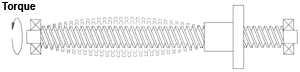
FIGURE 27
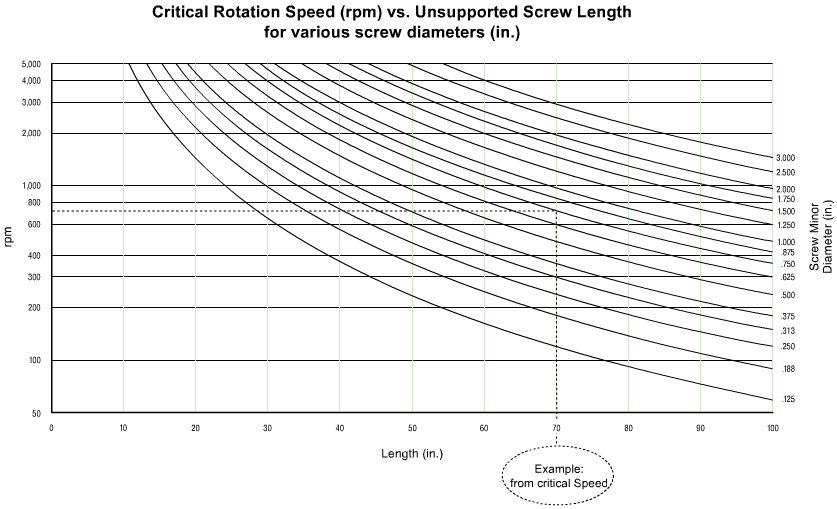
FIGURE 28

Column Loading back to top
Screws which are loaded in compression may be so slender (long in relation to diameter) that they can
fail by elastic instability (buckling) much before they reach their static load limit or compressive
strength. A screw system design which undergoes a compressive load must be checked for safe column
loading.
Basic safe column loads are shown in graphic form in (Figure 30). Using the minor diameter of the
screw from the Screw/Nut Engineering Data section for the selected screw and the unsupported length
of the screw, find the basic maximum column load from the graph. Calculate the safe column load
using this formula. If your actual load exceeds the calculated safe load, then increase the screw
diameter or change the end fixity. Repeat the process until the calculated safe load is greater
than your expected loads.
For example, a 1 - 5 Acme screw is selected to support a load of 7,000 lbs. with an unsupported
span of 30 in. The screw will have one end fixed and one end supported and a factor of safety of
1.75 will be used.
Using the screw minor diameter for a 1 - 5 Acme screw of .750 in. (from the Acme Screws/Nuts -
Engineering Data page) and a length of 30 in., the maximum column load of approximately 5,000 lbs.
can be read from this graph. The safe column load is 5,714 lbs. (5,000 lbs. x 2.0/1.75) where 2.0
is the correction factor for one end fixed and one end supported and 1.75 is the factor of safety.
Since the intended load of 7,000 lbs. exceeds the safe column load of 5,714 lbs., a larger screw
should be selected.
Using the same desired conditions as above, a 1 1/4 - 5 Acme screw will have a safe column of
18,286 lbs. From the graph at 1.00 minor diameter and 30 in., the basic maximum column load of
approximately 16,000 lbs. is read. The safe column load is 18,286 lbs. (16,000 x 2.0/1.75) where
2.0 is the correction factor for one end fixed and one end supported and 1.75 is the factor of
safety. The safe column load of 18,286 lbs. exceeds the desired load of 7,000 lbs. and the 1 1/4 -
5 size screw should be selected. Note how dramatically the safe column load increases. For a 25%
increase in screw major diameter, the safe column load increased from 5,714 lbs. to 18,286 lbs.
(An increase of 220%!)
All the data presented in Figure 23 are for ideal, pure axial loading, with supported-supported
end fixity. Off center loading and moment loading will require additional derating of the basic
column load. A screw lift system properly designed for pure axial loading may readily fail when
eccentric loading produces additional bending in the screw.
For data points beyond the range of the graphs, contact Roton Application Engineering.
FIGURE 29

FIGURE 30

Horizontal Bending back to top
Long screws mounted horizontally may sag due to the weight of the screw. If the sag is significant,
the screw threads will be compressed on the top section of the screw and extended on the bottom
section of the screw. In severe cases, the nut may actually seize on the screw as the running
clearance between the screw and nut threads disappears.
The calculations involved are beyond the scope of this section, but the designer needs to be
aware of the possibility of problems due to screw sag. If a long span is being used, increasing
the screw diameter will decrease the sag and help prevent nut seizure. For more detailed information
and the governing equations on horizontal bending of screw shafts, see Roton Engineering Bulletin
No. 974.
FIGURE 31

Torsional & Axial Deflection back to top
Screw torsional deflection (sometimes called "windup") may occur when loads are high (resulting in
high drive torques) and when the screw is long. Also screw axial deflection caused by high compression
or tension loads may be significant when loads are high and the screw is slender.
When rotation is used for feedback on a drive system, the engineer needs to be aware of these
phenomenons. When the load is not where it is supposed to be, based theoretically upon the screws
rotational position, screw deflections must be evaluated. For more detailed information and a listing
of the governing equations for torsional and axial deflection, see Roton Engineering Bulletin No. 974.
Wear Life - Power Screws back to top
The wear life of power screws is a function of load, speed, lubrication, contamination, heat and other
factors. The operating loads listed in the Screw/Nut Engineering section for each screw series provide
acceptable wear life for most applications.
Wear in a power screw is generally in proportion to usage. Each movement of the screw surface
against the mating nut surface removes a microscopic amount of material, usually from the softer nut
material. As these wear increments add up over time, and backlash increases, the nut threads become
thinner. When the shear strength of the remaining threads is exceeded by the load, failure occurs.
Although their wear life is not as predictable as Ballscrews, well lubricated power screws, without
side loads or moment loads, can provide excellent service lives for many applications. Heavy loads and
duty cycles which generate significant amounts of heat will cause material and lubricant breakdown and
should be avoided.
Every power screw application is unique in terms of loads, environment, duty cycle, etc. Operational
and life testing of prototypes is highly recommended especially for OEMs anticipating large volume
production. Customers are encouraged to contact Roton's application engineers who are available for
consultation and to discuss wear life objectives for specific applications. Often, a short evaluation
early in the application development can save many hours of design revision and testing.
Wear Life - Ballscrews back to top
The wear life of Ballscrews is much more predictable than power screws due to the large body of
research and testing that has been conducted on ball bearings and bearing balls. Assuming that a
Ballscrew is a ball bearing arranged with helical inner and outer races, the listed operating loads have
been determined.
The operating load ratings are based upon a theoretical 90% survival rate of Ballscrews at 1,000,000
in. of travel. Ratings also assume pure axial loading of the screw and nut with no side loads or moment
loads, and a clean, well lubricated, room temperature environment. The presence of unfavorable loading,
dirt, dust, lack of lubricant and external heat will dramatically reduce the service life.
Ballscrew life is proportional to the inverse cube of the load. If the load is cut in half, the life
increases by 2 cubed or a factor of 8. For example, a 1 x .250 Ballscrew is to be operated at 1,000 lbs.
The expected travel life of the Ballscrew with a 90% survival rate would be 4,100,000 inches of travel.
Dividing the operating load rating of 1,600 lbs. for this size Ballscrew (from Table 15) by the actual
load of 1,000 lbs., cubing the result and multiplying by 1,000,000 inches yields the expected life:
(1,600/1,000)3 x 1,000,000 = 4,100,000 inches. The formula for Ballscrew wear life can be found in
Useful Formulas.
Every application is unique in terms of loads, environment, duty cycle, etc. Operational and life
testing of prototype Ballscrews is recommended especially for OEMs anticipating large volume production.
Customers are encouraged to contact Roton's application engineers who are available for consultation and
to discuss wear life objectives for specific applications.
Cost Considerations back to top
The products in this catalog are arranged in increasing cost order from front to back. Acmes are the
least expensive and are the most widely used. Hileads(r), Torqsplines(r) and Ballscrews offer increased
performance at increased costs.
The final choice depends upon the user's economics, the market for the end product, reliability
objectives, and many other factors. Bear in mind that initial cost is only one element in the cost
equation. Installed cost, maintenance, consequences of failure and many other items need to be weighed
before finalizing any design.